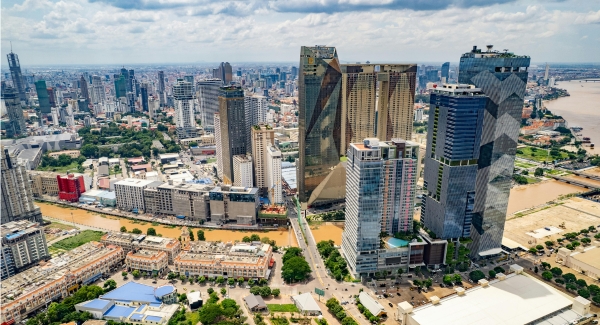
2026 Market Outlook: Where Smart International Investors Are Moving as Thailand Crashes, Vietnam Explodes, and Cambodia Quietly Recovers
Research and analysis by RielProperty.com | November 2025
Global condominium prices have reached unprecedented levels in 2025, with Hong Kong topping the charts at over $25,000 per square meter and prime markets in Monaco, New York, and London commanding even higher prices in the luxury segment. Meanwhile, Southeast Asia presents a study in contrasts: Thailand’s condo market has collapsed to a 16-year low, Vietnam’s prices have surged 47% year-on-year, and Cambodia is quietly positioning itself as the region’s most compelling value proposition for international investors.
For buyers from the United Kingdom, the United States, the United Arab Emirates, and Poland seeking overseas property investments with strong fundamentals, understanding these divergent market trajectories is essential. This analysis examines the data behind each market and projects where the smart money is likely to move through 2026.
The Global Context: Record-High Condo Prices in 2025
According to the latest cost-of-living data from Numbeo, compiled by Visual Capitalist, the world’s most expensive condominium markets are concentrated in a handful of high-income regions. Hong Kong maintains its long-standing lead with condos averaging approximately $25,300 per square meter, reflecting the city’s limited land supply, high population density, and enduring appeal as a financial hub.
| Global Rank | City | Price per sqm (USD) | vs Phnom Penh |
|---|---|---|---|
| #1 | Hong Kong | $25,300 | 12.3x more expensive |
| #4 | Singapore | $22,500 | 11.0x more expensive |
| #10 | London, UK | $19,700 | 9.6x more expensive |
| #11 | New York City, USA | $16,100 | 7.8x more expensive |
| — | Phnom Penh, Cambodia | $2,050 | Base Value |
Source: Numbeo, Visual Capitalist, RielProperty.com analysis, November 2025
For international investors seeking capital appreciation and rental yields without paying premium prices, the question becomes: where can similar growth potential be found at a fraction of the entry cost?
Prime Residential Markets: The Luxury Segment
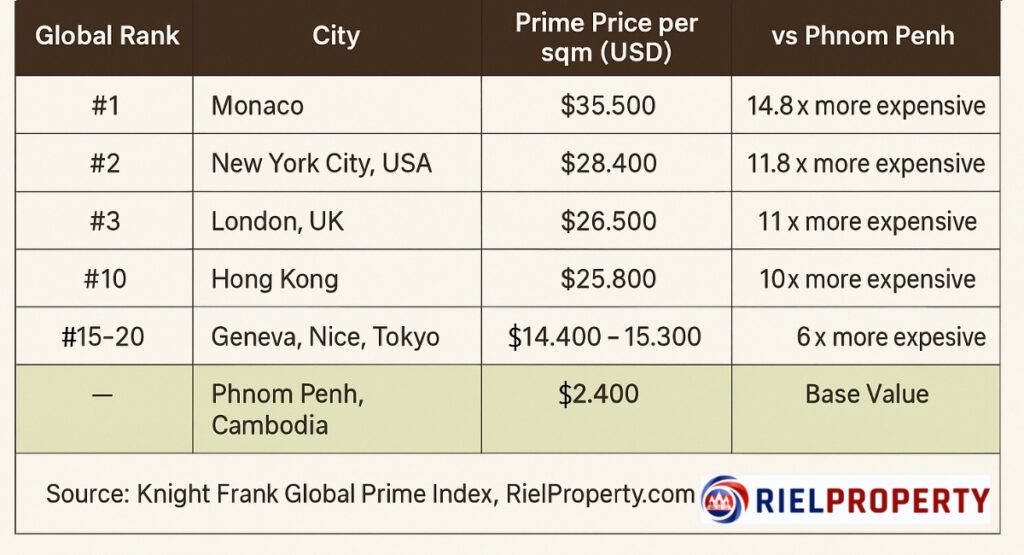
In the ultra-prime segment, the price differential becomes even more dramatic. Monaco leads globally at $35,500 per square meter, while prime properties in New York, London, and Hong Kong command prices that make Phnom Penh appear almost free by comparison.
| Global Rank | City | Prime Price per sqm (USD) | vs Phnom Penh |
|---|---|---|---|
| #1 | Monaco | $35,500 | 14.8x more expensive |
| #2 | New York City, USA | $28,400 | 11.8x more expensive |
| #3 | London, UK | $26,500 | 11x more expensive |
| #4 | Hong Kong | $25,800 | 10.4x more expensive |
| #10 | Singapore | $16,300 | 6.8x more expensive |
| #15-20 | Geneva, Nice, Tokyo | $14,400 – $15,300 | ~6x more expensive |
| — | Phnom Penh, Cambodia | $2,400 | Base Value |
Source: Knight Frank Global Prime Index, RielProperty.com analysis, November 2025
The 2026 Macro Backdrop: Southeast Asia’s Diverging Trajectories
Regional GDP growth into 2026 is expected to be led by Vietnam, with Southeast Asia as a whole projected to grow in the mid-4% range. This growth is underpinned by manufacturing relocation from China, tourism recovery following the pandemic, and substantial infrastructure investment pipelines across the region.
However, high global interest rates, tighter credit conditions, and post-pandemic overbuilding mean the benefits will be distributed unevenly across countries and market segments. The three major ASEAN property markets present starkly different investment propositions heading into 2026.
Thailand: From Stagnation to Crisis Conditions
Thailand’s residential property market is experiencing what analysts describe as “crash-like” conditions. The condominium segment in Bangkok has contracted to its lowest level in 16 years, with new launches plummeting to just 373 units in the second quarter of 2025. This represents a staggering 94.2% year-on-year contraction and marks the weakest market activity since the 2009 subprime crisis recovery.
| Thailand Market Indicators (2025) | |
|---|---|
| Condo Launch Contraction | 94.2% year-on-year decline |
| Q2 2025 New Launches | 373 units (lowest since 2009) |
| Mortgage Rejection Rate | 70% |
| Household Debt to GDP | 88% |
| Vacant Housing Stock | 1.64 million units (THB 3.45 trillion value) |
| Market Value Decline | Projected 700 billion baht (steepest since 1997 crisis) |
| Expected Recovery Timeline | 2-3 years minimum |
Sources: Nation Thailand, Colliers Thailand, Thailand Business News
The fundamental problem is a credit bottleneck driven by exceptionally high household debt. With debt levels at 88% of GDP and mortgage rejection rates reaching 70%, many genuinely interested buyers cannot secure financing. The seemingly vibrant rental market is driven not by lifestyle preferences but by necessity, as younger adults with volatile incomes increasingly view homeownership as financially unviable.
Industry leaders estimate the residential market value could decline to approximately 700 billion baht in 2025, representing the steepest drop since the 1997 Asian financial crisis. While household debt has begun edging down modestly from its 91% peak, analysts broadly agree the property market will take 2-3 years to regain clearer momentum.
2026 Outlook: Thailand is likely to face a painful, slow-burning correction through 2026. The oversupply of over 1.6 million vacant units, combined with constrained credit access and weak consumer confidence, suggests that bargain hunters entering the Thai market should be prepared for an extended holding period before meaningful appreciation returns.
Vietnam: The Explosive Surge
In stark contrast to Thailand’s malaise, Vietnam’s property market has entered an unprecedented growth phase. Ho Chi Minh City apartment prices reached a record $4,691 per square meter in Q2 2025, representing a remarkable 47% year-on-year increase. Prices have jumped nearly 28% since late 2024 alone, according to Cushman and Wakefield’s latest market report.
| Ho Chi Minh City Market Indicators (2025) | |
|---|---|
| Average Primary Price | $4,691/sqm (record high) |
| Year-on-Year Increase | 47% |
| Luxury Segment Growth | 30-50% annual increases |
| Prime District Pricing | $5,400 – $15,000/sqm |
| Thu Thiem Financial District | $6,500+/sqm (10-20% growth in H1 2025 alone) |
| Landed Housing Growth | 41% annual appreciation |
| GDP Growth (2024) | 7.09% |
Sources: Cushman and Wakefield, Bamboo Routes, InvestAsian
The surge varies significantly across market segments. Branded residences and luxury apartments are leading with 30-50% year-on-year increases, commanding prices of $5,400 to $15,000 per square meter. Thu Thiem, the emerging financial district, has seen prices exceed $6,500 per square meter with 10-20% growth in the first half of 2025 alone, building on 50-220% appreciation over the past five years.
Vietnam combines one of the strongest growth outlooks in ASEAN with a rapidly expanding digital and manufacturing economy. The country’s GDP grew 7.09% in 2024, and upcoming market classification upgrades are expected to unlock additional foreign capital. Infrastructure investments, including the newly operational Metro Line 1, continue to support property values in connected districts.
However, international buyers should understand Vietnam’s ownership restrictions:
| Vietnam Foreign Ownership Restrictions | |
|---|---|
| Ownership Type | Leasehold only (no freehold for foreigners) |
| Maximum Term | 50 years (renewable once) |
| Ownership Cap per Building | 30% of total units |
| Landed Property Cap | 10% of units or 250 houses per ward |
| Land Ownership | Prohibited (land belongs to the state) |
| Renewal Guarantee | Subject to government approval (not automatic) |
2026 Outlook: Vietnam looks set for renewed outperformance and strong new-cycle growth. However, international investors entering now are buying at or near peak prices with leasehold constraints and ownership caps that limit flexibility. The 47% surge suggests much of the easy money has already been made, and buyers should carefully evaluate whether current valuations are sustainable.
Cambodia: The Quiet Recovery and Compelling Value
Cambodia presents a fundamentally different proposition. After the construction boom of 2015-2019 left the market oversupplied and the subsequent correction saw prices decline approximately 2% nominally (over 5% in real terms) through 2024, Phnom Penh is now showing concrete signs of a value-driven recovery.
Knight Frank’s H1 2025 report confirms that the Cambodian real estate sector recorded its strongest performance during Q1 2025 since the pandemic, with condominium sales in the first half of 2025 reaching the highest levels since 2020. The market shift reflects a move away from speculative foreign investment toward real demand, with local Cambodian buyers now comprising 18.2% of the market, a significant increase from pre-pandemic levels when Chinese investors dominated.
| Phnom Penh Market Indicators (2025) | |
|---|---|
| H1 2025 Performance | Highest condo sales since 2020 |
| Total Condo Supply | 61,564 units |
| Construction Project Approvals | 1,300 projects (18% YoY increase) |
| Investment Projects Approved (Jan-Apr 2025) | $3.4 billion (34% YoY increase) |
| Cambodian Buyer Share | 18.2% (growing rapidly) |
| Most Popular Unit Type | 1-bedroom (61% of market) |
| GDP Growth (H1 2025) | Nearly 6% |
Sources: Knight Frank Cambodia H1 2025, Realestate.com.kh, National Bank of Cambodia
Phnom Penh Condo Prices by District
| District | Market Segment | Avg. Price/sqm (USD) | Typical Buyer |
|---|---|---|---|
| BKK1 (Prime Central) | Luxury/High-End | $2,400 – $2,924 | Expats, HNW investors |
| Chamkarmon | Mid-to-High | $2,200 | Mixed local/foreign |
| Target Sweet Spot | Mid-Range Prime | $2,050 | Value-focused investors |
| Chroy Changvar | Emerging Riverside | $1,700 | Infrastructure-led growth |
| Chbar Ampov | Value/Emerging | $1,600 | New transport links |
| Toul Kork | Mid-Range Residential | $1,450 | Growing middle class |
| Suburban/Outer Districts | Budget/Entry-Level | $1,000 – $1,500 | First-time buyers, rentals |
Source: CBRE Cambodia, Knight Frank, Realestate.com.kh, RielProperty.com, November 2025
The Freehold Advantage
Unlike Vietnam and Thailand, Cambodia offers foreign buyers genuine freehold ownership of condominium units above the ground floor. This represents the only fully foreign-friendly freehold strata title system in mainland Southeast Asia.
| Country | Ownership Type | Foreign Restrictions | Term |
|---|---|---|---|
| Cambodia | 100% Freehold | Above ground floor only; no per-building cap | Perpetual |
| Vietnam | Leasehold only | 30% cap per building | 50 years (renewable once) |
| Thailand | Leasehold for land | 49% foreign quota per building | 30 years (extendable) |
| Singapore | Freehold available | 60% ABSD stamp duty for foreigners | Perpetual |
| Hong Kong | Freehold available | 30% stamp duty for non-residents | Perpetual |
Government Stimulus Measures
The Cambodian government has implemented significant incentives to support the property market through 2025:
| 2025 Tax Incentives for Property Buyers | |
|---|---|
| First-Time Buyer Exemption | Full stamp duty exemption on properties up to $210,000 |
| Properties Over $210,000 | $210,000 deducted from stamp duty base |
| Second Property Deduction | $70,000 deducted from stamp duty base |
| Capital Gains Tax | Deferred until end of 2025 |
| Effective Period | January 1 – December 31, 2025 |
Source: Ministry of Economy and Finance Notification No. 020 (December 31, 2024)
2026 Outlook: Cambodia appears to be moving from post-bubble stagnation into a value-driven recovery phase where prime condos remain dramatically cheaper than regional peers. The combination of freehold ownership, government incentives, growing local demand, and early-cycle positioning makes it arguably the most compelling entry point in Southeast Asia for long-term investors willing to accept emerging market risk.
The Value Comparison: What Does Your Money Buy?
The following comparison illustrates the dramatic price differential between Phnom Penh and competing Southeast Asian markets:
Southeast Asia Condo Price Comparison
| City | Property Type | Price per sqm (USD) | vs Phnom Penh ($2,050) |
|---|---|---|---|
| Bangkok, Thailand | Prime Central Condo | $4,100 – $8,200 | 2x to 4x more expensive |
| Ho Chi Minh City, Vietnam | Mid-to-High Condo | $2,500 – $5,900 | 1.2x to 2.8x more expensive |
| Manila, Philippines | Average Condo | $3,000 – $5,300 | 1.5x to 2.5x more expensive |
| Phnom Penh, Cambodia | Luxury/High-End Condo | $2,400 | Slightly above target |
| Phnom Penh, Cambodia | Mid-Range/Prime Condo | $2,050 | Base Value |
| Phnom Penh, Cambodia | Suburban/Budget Condo | $1,000 – $1,500 | Significantly lower |
Source: Knight Frank, CBRE Cambodia, Cushman & Wakefield, RielProperty.com analysis, November 2025
The $100,000 Test: What Can You Buy?
| City | Price/sqm | What $100,000 USD Buys |
|---|---|---|
| Hong Kong | $25,300 | ~4 sqm (a closet) |
| Singapore | $22,500 | ~4.5 sqm (a closet) |
| London | $19,700 | ~5 sqm (a bathroom) |
| New York City | $16,100 | ~6 sqm (a bathroom) |
| Bangkok (Prime) | $4,100 – $8,200 | ~12-24 sqm (studio) |
| Ho Chi Minh City | $2,500 – $5,900 | ~17-40 sqm (studio to 1-bed) |
| Phnom Penh (Mid-Range) | $2,050 | ~49 sqm (1-bedroom apartment) |
| Phnom Penh (Suburban) | $1,000 – $1,500 | ~67-100 sqm (spacious 2-bedroom) |
Source: RielProperty.com analysis, November 2025
Understanding the Risks: A Balanced Assessment
While Cambodia presents compelling value, international investors should understand the risks inherent in this emerging market:
Financial Sector Concerns
The International Monetary Fund’s September 2025 Article IV consultation raised several concerns about Cambodia’s financial sector:
| Cambodia Financial Indicators | |
|---|---|
| Non-Performing Loans (NPLs) | Surpassed 7% (up from 2% pre-pandemic) |
| Projected NPL Peak | 7.7% in 2026 (S&P Global Ratings estimate) |
| Credit-to-GDP Ratio | 134.5% (significantly elevated) |
| Restructured Loans | $4 billion with 287,000 customers |
| High-End Condo Vacancy | 30-50% |
| GDP Growth Forecast 2025 | 4.8% (revised down due to regional tensions) |
Sources: IMF Article IV Consultation 2025, S&P Global Ratings, National Bank of Cambodia
The IMF has urged Cambodia to phase out forbearance measures and develop a comprehensive plan to safeguard financial stability. Rising NPLs in the tourism and real estate sectors pose risks to both growth and economic stability, particularly if credit conditions tighten further.
Cambodia’s mortgage market also recorded its first-ever annual contraction in 2024, falling 5% year-on-year to $6.77 billion, with further contraction of 3.5% in January 2025. This represents the first decline since mortgages were introduced in 2008 and signals ongoing caution in the financing sector.
Geopolitical Factors
The ongoing Cambodia-Thailand border dispute has created uncertainty, particularly impacting tourism arrivals and investor sentiment. While a ceasefire has been established, the medium-term resolution remains unclear and could affect economic growth projections.
Mitigating Factors
Several factors offset these concerns:
The government has implemented proactive stimulus measures, including the $210,000 stamp duty exemption, loan restructuring programs extended through the end of 2025, and continued infrastructure investment. The National Bank of Cambodia has directed financial institutions to restructure loans without restrictions, maintaining interest rates for customers facing cash flow difficulties.
Additionally, the shift toward local buyer demand (now 18.2% of the market) suggests healthier, end-user-driven growth rather than speculative foreign investment. Developers have improved their understanding of market dynamics and are offering more favorable payment terms, contributing to the strongest sales performance since the pandemic.
Investor Profiles: Who Should Consider Cambodia?
Ideal Candidate Profile
Phnom Penh condominiums are best suited for:
UK Investors: With GBP strength against the USD and limited exposure to Southeast Asian real estate, British investors can capitalize on attractive entry points while diversifying away from overheated domestic and European markets. The dollarized economy eliminates currency risk relative to the US dollar.
US Investors: For American buyers, Cambodia offers a dollar-denominated asset class with yields significantly exceeding US Treasury rates and most domestic rental markets. The time zone differential supports remote management through established property management services.
UAE-Based Investors: Dubai and Abu Dhabi residents seeking geographic diversification beyond the Middle East and established Asian markets will find Cambodia’s freehold structure familiar and the entry costs substantially below comparable UAE opportunities.
Polish and European Investors: With EU property markets facing regulatory constraints and elevated prices, Polish and other European investors increasingly seek ASEAN exposure. Cambodia’s straightforward foreign ownership laws and English-language business environment lower barriers to entry.
Investment Thesis Summary
| Factor | Thailand | Vietnam | Cambodia |
|---|---|---|---|
| Market Cycle Position | Bottom/Crisis | Peak/Expensive | Early Recovery |
| Price Trajectory | Declining | +47% YoY | Stabilizing/Rising |
| Foreign Ownership | 49% cap, 30yr lease | 30% cap, 50yr lease | 100% freehold |
| Mid-Range Price/sqm | $4,100 – $8,200 | $2,500 – $5,900 | $2,050 |
| Rental Yield | 4-5% | 5-8% | 6-7% |
| Government Stimulus | Slow to respond | Regulatory reforms | $210K tax exemption |
| 2026 Outlook | Slow-burn correction | Strong growth, high entry | Value recovery |
Conclusion: The Contrarian Opportunity
As global condo prices reach record highs and investors chase returns in Vietnam’s surging market or wait out Thailand’s prolonged correction, Cambodia presents a differentiated opportunity that deserves serious consideration.
The numbers tell a compelling story: at $2,050 per square meter for mid-range Phnom Penh condominiums, prices are over 12 times lower than Hong Kong, 11 times lower than Singapore, and roughly 20-50% below current Ho Chi Minh City levels. When combined with freehold ownership rights unavailable elsewhere in mainland Southeast Asia, rental yields of 6-7%, and active government stimulus measures, the risk-adjusted value proposition becomes difficult to ignore.
This is not to suggest Cambodia is without risk. Rising NPLs, elevated credit levels, and geopolitical uncertainty require careful due diligence and a longer-term investment horizon. The high-end segment remains oversupplied, and buyers should focus on well-located, well-built developments from reputable developers with proven track records.
However, for international investors from the UK, USA, UAE, Poland, and beyond who are willing to accept emerging market dynamics in exchange for compelling entry prices and genuine ownership rights, Cambodia’s quiet recovery phase may represent the most attractive risk-reward opportunity in Asian real estate heading into 2026.
As the saying goes, the best time to buy is when others are not yet paying attention. With Thailand crashing, Vietnam exploding to record highs, and Cambodia quietly finding its footing, the smart money may well be moving to where value still exists.
About This Research
This analysis was compiled by RielProperty.com using data from Knight Frank Cambodia H1 2025 Report, CBRE Cambodia, Realestate.com.kh Investment and Market Analysis 2025, IMF Article IV Consultations, National Bank of Cambodia, Cushman and Wakefield Vietnam, Colliers Thailand, Nation Thailand, Visual Capitalist/Numbeo global condo price rankings, and various industry sources. All figures are current as of November 2025.
Disclaimer: This article is for informational purposes only and does not constitute investment advice. Property investments carry risks, including potential loss of capital. Prospective investors should conduct their own due diligence and consult qualified professionals before making investment decisions.

Thomas Kaspersky
I’m Thomas Kaspersky, specialising in property investment across several markets, including Cambodia, the UK, Dubai/UAE, and Poland. With experience as an engineer and project manager, I enjoy explaining how developments, construction, and market data shape real estate opportunities.
View all posts