Headlines about Cambodia’s property market in 2026 tend to say one of two things: prices are falling, or prices are recovering. Both are true, depending on which segment of the market you are looking at, and conflating the two leads to bad decisions. The national price index has now declined for nearly 30 consecutive months, yet prime Phnom Penh condos have quietly risen in value over the same period.
This guide explains why the national index and prime condo prices are moving in opposite directions, what is driving the split, and how to read the market correctly before you buy.

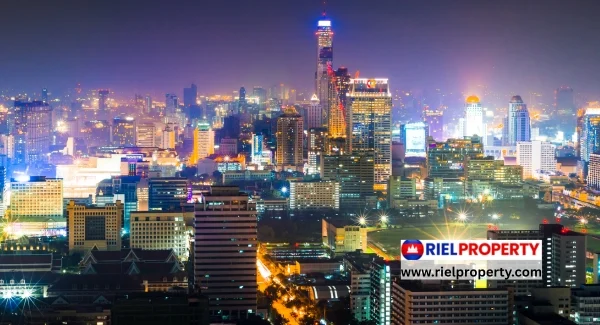
Prime condos in BKK1 and Tonle Bassac are rising in value even as Cambodia’s national price index falls.
What the National Index Actually Shows
Cambodia’s broad residential price index shows that average home prices are still in a gentle but persistent correction. One widely cited series reports nationwide residential prices down by roughly low-single-digit percentages year on year in early 2026, after more than two years of mostly negative readings. Phnom Penh’s own index is softer than the national average, reflecting a heavier weight of condo stock and earlier overbuilding in the capital.
These indices cover the full range of housing stock: older apartments, fringe condos, borey homes, provincial houses and coastal projects. That means weak segments, such as oversupplied coastal condos or aging towers in less attractive locations, pull down the average even when better quality stock is already stabilizing or rising. In other words, the index tells you where the weakest parts of the market are, not where all of the opportunity sits.
Why Prime Condos Are Moving the Other Way
Data for the high-end condo segment in Phnom Penh tells a different story. Market tracking for late 2025 shows average asking prices for better quality condominiums in core districts up by around mid-single digits year on year, with values above 2,800 dollars per square meter in the strongest projects. Adjusted for inflation, that still means a real increase in prime segment pricing.
This is not a blanket “condos are recovering” message. The gains are concentrated in well-located, well-managed projects from established developers, mainly in BKK1, Tonle Bassac and selected riverfront locations such as Koh Pich. Older towers, buildings in weaker districts, and projects with poor management or incomplete amenities often remain under pressure. The national index averages those stories together; prime segment data isolates the better end of the market that most serious foreign buyers focus on.
Borey Housing Is Doing the Heavy Lifting
The most important part of the 2026 picture sits in transaction volumes. Overall home sales are up strongly compared with the previous year, but the growth comes largely from borey and other landed housing, not from condos. These are the houses and townhouses aimed at Cambodia’s growing middle class, usually located in emerging corridors around Phnom Penh and key provincial centers.
Developers in these segments have adapted more quickly to the new environment. They have launched smaller phases, offered more flexible payment terms, and focused on real end-user buyers rather than speculative traders. Banks remain cautious, but borey projects often work with structured payment plans that bridge the gap between savings and formal mortgage finance. As a result, landed housing is absorbing much of the real demand that previously spilled over into condo projects during the boom.
2026 Market Snapshot
- National residential index: down modestly year on year after a multi-year decline
- Prime Phnom Penh condo prices: up mid single digits in better projects
- Total home sales: up by more than 30 percent, led by landed housing
- Condo sales volumes: down by roughly 20 percent compared with the prior year
Why Condo Sales Are Still Lagging
Several factors explain why condo sales data still looks weaker, even as prime prices edge higher. First, the oversupply hangover from the pre-2020 building boom remains significant in certain districts. There are still many units to absorb in older or less well-located buildings before the market feels tight enough for a broad price lift.
Second, Cambodian banks have become more cautious about real estate lending. Growth in mortgage balances has slowed, and the share of mortgages relative to GDP has slipped back from earlier highs, reflecting tighter standards and more careful risk management. That reduces buying power for some local condo purchasers and makes it harder for weaker developers to refinance or launch new projects.
Third, external demand has softened compared with pre-pandemic peaks. Regional trade friction, higher interest rates globally and concerns about construction-linked nonperforming loans have all contributed to a more cautious stance among foreign and regional investors. Together, these factors mean that the condo segment, especially outside the prime districts, is working through a slower, more selective recovery than borey housing.
How to Actually Read This as a Buyer
The practical takeaway is that Cambodia’s property market in 2026 is running at two speeds. One speed is the broad average, pulled down by weaker segments and reflected in the national index. The other is the prime and borey segments, where selective price growth and stronger volumes are already visible.
Reading only the national index leads to one mistake: assuming everything is in trouble and ignoring genuine opportunities in better projects and districts. Reading only prime condo data leads to the opposite mistake: assuming the entire condo market has recovered, when in fact many buildings are still correcting. A smarter approach is to ask three questions before you commit: which segment, which district, and which developer track record are you really buying?
If you are focused on rental yield and long-term capital preservation, your natural hunting ground is the better quality stock in established districts such as BKK1 and Tonle Bassac. These areas combine proven tenant demand, deeper resale markets and more professional management. Buying here does not guarantee gains, but it means you are aligned with the part of the market where prices have already started to stabilize and recover.
If you are more interested in domestic demand and family housing, borey projects and landed homes in emerging corridors like Sen Sok, Chbar Ampov, Chroy Changvar and parts of Mean Chey are where most of the volume growth is coming from. The risk profile is different: less exposure to foreign investor sentiment, more exposure to local incomes and infrastructure delivery, but the underlying demand is real.
Cash buyers have an edge in this environment. Because tighter bank lending is one of the main forces slowing the condo segment, a buyer who does not need mortgage approval can move faster on well-priced units in good projects. That is especially true for ready units where prices and rental performance can be tested in real time.
If you want to explore ready stock, start with our page for ready to move in properties, where you can filter by district and price band. For investors who are comfortable with longer timelines and staged payments, our list of off plan properties shows current launches in prime and growth corridors.
Before you commit to any developer or project, it is worth reading our guide on developer distress risk in Cambodia, which explains how to spot weaker balance sheets and unfinished projects. For a broader context on taxes, ownership rules and exit strategies, our full set of investment guides for foreign buyers walks through the key steps and common pitfalls.
Frequently Asked Questions
Are Cambodia property prices going up or down in 2026?
Both. The broad national index is still down, reflecting weakness in parts of the market, while prime Phnom Penh condos and many borey projects are either stable or rising. The direction depends on the segment and location.
Is it a good time to buy a condo in Cambodia?
It can be, if you focus on the right projects. Well-located, well-managed condos from established developers in core districts are a very different proposition from older, oversupplied buildings. Segment and project selection matter more than the headline index.
Why are condo sales falling while total home sales are rising?
Most of the sales growth is coming from borey and landed housing bought by domestic end users, supported by realistic pricing and flexible payment plans. Condo sales are lagging due to oversupply in some areas, more cautious bank lending and softer speculative demand.
Does a falling national index mean my Cambodia investment is losing value?
Not necessarily. The index is a broad average. A prime unit in a strong district can rise in value even while weaker parts of the market pull the average down. The key is where your specific asset sits in the spectrum.
Why do cash buyers have an advantage right now?
Tighter lending standards slow down financed purchases and limit some buyers’ ability to act. A cash buyer who does not need mortgage approval can move faster on good opportunities and is often more attractive to developers and sellers who want certainty.

Thomas Kaspersky
I’m Thomas Kaspersky, specialising in property investment across several markets, including Cambodia, the UK, Dubai/UAE, and Poland. With experience as an engineer and project manager, I enjoy explaining how developments, construction, and market data shape real estate opportunities.
View all posts