This guide explains which Phnom Penh neighborhoods are gaining and which are lagging as Techo Airport reshapes the city, and what that means for your next purchase.

The southern corridor linking Phnom Penh to Techo International Airport is emerging as the city’s fastest-growing property zone.
The Airport, Briefly
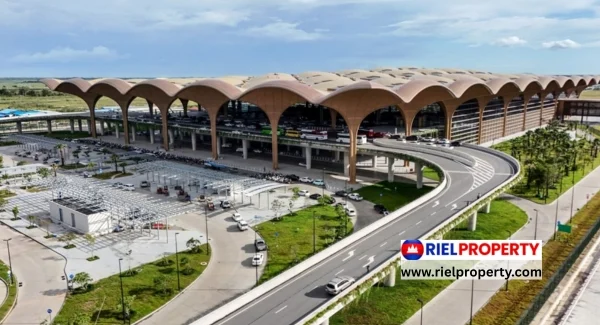
Techo International Airport opened for commercial flights in late 2025, taking over from the old Phnom Penh International Airport after roughly seven decades of service. The new airport sits about 20 kilometers south of the city center in Kandal province, covers several thousand hectares, and is classified to handle wide body international aircraft in multiple expansion phases.
The first phase is designed for around 13 million passengers a year, with capacity rising toward 30 million and higher in later phases. A dedicated highway links the airport to the southern end of Hun Sen Boulevard and National Road 2, and an airport express bus now runs daily between the terminal and central Phnom Penh. This access corridor, more than the terminal building itself, is what is quietly redrawing value across the city.
Neighborhoods Gaining From the Shift
The clearest beneficiaries so far are the districts that sit along or near the new southern and northern access routes.
- Sen Sok is seeing some of the fastest growth, with landed housing prices estimated to be rising in the mid single digits annually, helped by new roads, retail and a growing middle class buyer base.
- Mean Chey and Chbar Ampov are recording price growth ahead of the citywide average, supported by easier access to the airport corridor and new family housing projects.
- Chroy Changvar is also benefiting, combining riverfront development momentum with improved links across the city, with annual gains stronger than in more mature districts that are not directly on new routes.
The underlying drivers are similar in each case. Commute times to the new airport and to emerging employment corridors are shrinking, and day-to-day services such as retail, schools, and healthcare are catching up. That mix is pulling in end-user buyers, families buying homes to live in, instead of just speculative investors. Analysts note that this kind of owner-occupier demand tends to produce steadier, more durable price growth than the investor-led buying that drove Cambodia’s earlier condo boom.
| District | Estimated Annual Growth | Primary Driver |
|---|---|---|
| Sen Sok | Mid single digits | Infrastructure build out, middle class demand |
| Chroy Changvar | Above city average | Riverfront projects, improved connectivity |
| Mean Chey | Moderate growth | Airport corridor access, family housing |
| Chbar Ampov | Moderate growth | Southern expansion, better road links |
One area to watch, rather than treat as a finished story, is Prek Pnov. It is absorbing a growing share of new residential supply. It could see stronger appreciation if planned infrastructure and services are delivered on schedule. Still, it carries more execution risk than the more established growth districts above because much of its growth thesis depends on projects still under construction.
Areas Losing Relative Ground
The flip side of moving the main airport south is that parts of the city that once relied on proximity to the old airport for their appeal have lost that specific advantage. The change is gradual, not sudden, and these districts still have reasons for people to live and invest there, but buyers who care about long-term appreciation need to factor the shift in rather than assume the old patterns will hold forever.
What This Means for BKK1, Tonle Bassac, and Toul Kork
BKK1 and Tonle Bassac remain Phnom Penh’s core premium neighborhoods. They have the deepest base of embassies, international schools, restaurants, and long-established infrastructure, built up over two decades, and they still hold much of the foreign buyer condo stock that performs best on rental and resale. The airport move does not change that. For investors who prioritize rental liquidity and exit demand, these districts remain the safest and most proven choices.
Toul Kork faces more of a repositioning. During the last decade, it built much of its appeal on being close to the old airport while still offering relatively easy access to the city center. With the old airport closed to regular commercial flights and new growth corridors stretching south and east, that locational edge has narrowed. Toul Kork is still a comfortable area with established amenities, but it now looks more like a lifestyle choice than a district set up for outsized capital growth over the next cycle.
A quick district checklist for buyers
- Prioritizing rental yield and resale liquidity now: BKK1, Tonle Bassac
- Prioritizing long term capital growth on a longer hold: Sen Sok, Chroy Changvar, Chbar Ampov, parts of Mean Chey
- Prioritizing lifestyle over growth: Toul Kork remains a solid, established neighborhood
- Comfortable with more execution risk for higher potential upside: Prek Pnov and other emerging corridors
A Slow Moving Trend, Not an Overnight One
Infrastructure driven repricing happens over years, not months. Techo Airport has been open for less than a year, ring roads and connecting highways are still being completed, and the growth differentials described here are based on early sets of data and market observations since the airport opened. The key is direction: premium core districts remain strong, airport corridor districts are gaining, and some older areas built around the former airport are flattening out.
What This Means for Your Next Purchase
If your main goal is long-term capital appreciation and you are comfortable with a multi-year hold, the southern and northern corridors, especially Sen Sok, Chbar Ampov, Chroy Changvar and parts of Mean Chey, are where the infrastructure dividend is currently landing. For buyers who care more about rental demand, ease of resale and lifestyle right now, BKK1 and Tonle Bassac remain the lower risk, higher certainty choices.
If your priority is long-term growth, the emerging southern and northern corridors continue to offer some of the most interesting opportunities for investors prepared to hold for several years. Many of the latest developments in these areas are available as off plan properties, often with flexible payment plans and attractive launch pricing.
Buyers who prefer an established neighborhood with completed infrastructure and the ability to complete a purchase more quickly may find greater value in our selection of ready to move in properties. These are particularly suitable for investors looking to generate rental income without waiting for construction to finish.
Every district has its own strengths, whether you are focused on rental demand, capital appreciation or long-term lifestyle appeal. Our guide to Phnom Penh’s best areas compares the city’s leading neighborhoods in detail and can help narrow your search before viewing specific developments.
If you are still researching the Cambodian market, you’ll also find practical advice throughout our investment guides for foreign buyers, covering everything from legal ownership and taxation to financing, rental yields and exit strategies.
Frequently Asked Questions
Is Toul Kork still worth buying in?
Yes, for buyers who value its existing amenities and lifestyle. It is less compelling for investors whose main focus is capital growth tied to new infrastructure, because its relative locational advantage has narrowed since the old airport closed.
How long will it take for the airport corridor districts to fully mature?
Looking at similar infrastructure driven growth stories in Southeast Asia, meaningful maturity often takes five to ten years. Early movers tend to capture more upside, but the process is gradual and depends on roads, utilities and services being delivered as planned.
Are BKK1 and Tonle Bassac still the safest choice for foreign buyers?
Yes, for buyers who prioritize rental demand and resale liquidity. Both districts have the longest track record of foreign buyer activity and the most established amenity base in Phnom Penh.
Can I buy in these growth corridors with cash to move faster?
Yes. Many off-plan projects in these areas can be secured with a cash deposit and staged payments, which is often faster than waiting for mortgage approval. Cash purchases are a common way for overseas buyers to act quickly once they decide on a unit.

Thomas Kaspersky
I’m Thomas Kaspersky, specialising in property investment across several markets, including Cambodia, the UK, Dubai/UAE, and Poland. With experience as an engineer and project manager, I enjoy explaining how developments, construction, and market data shape real estate opportunities.
View all posts