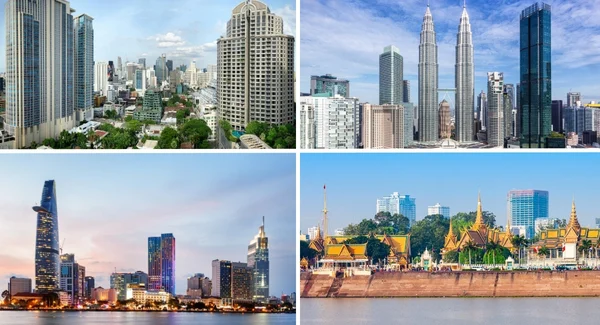
Southeast Asia attracts more international property capital than any other emerging market region in the world. The combination of fast-growing economies, improving infrastructure, expanding middle classes, and relatively accessible entry prices pulls investors from Europe, the Middle East, Russia, Australia, and beyond into a market that spans six countries, dozens of legal frameworks, and yield profiles ranging from disappointing to genuinely compelling. The difficulty is that the headline narrative, “buy in Southeast Asia for high yields and capital growth,” conceals enormous variation in what foreigners can actually own, what they actually earn, and how exposed they actually are to risks that brochures consistently omit.
This article examines four of the region’s most actively marketed property destinations for international buyers: Thailand, Malaysia, Vietnam, and Cambodia. Each market has genuine strengths. Each carries specific structural limitations that sophisticated investors need to understand before committing capital. The comparison is built on ownership rights, supply conditions, pricing, yield data, and the practical realities of holding and exiting a foreign-owned property in each jurisdiction.
Choosing the right market requires more than just looking at a few numbers; it requires a deep dive into the specific legal and economic nuances of each jurisdiction. For a more granular, data-driven look at how these markets stack up—including interactive charts on historical growth and detailed tax breakdowns—visit our comprehensive Riel Property’s Cambodia vs Thailand vs Vietnam comparison guide.
However, a successful investment doesn’t end at the point of purchase. Strategic investors know that long-term returns are defined by management, tenant quality, and maintenance standards. To see how we protect your asset once the title is in your name, explore the Riel Property after-sales support overview, which details our full ownership journey from unit handover to professional rental management.
Four-Market Comparison: 2026 Key Metrics
| Factor | Cambodia | Thailand | Malaysia | Vietnam |
|---|---|---|---|---|
| Ownership Type | ✅ Freehold Strata | ⚠️ Freehold (Condo Only) | ✅ Freehold / Leasehold | ⏳ 50-year Leasehold |
| Foreign Cap | 70% of building | 49% (⚠️ Strict) | No cap | 30% (⚠️ Project Quota) |
| Price per sqm | $1,600–$3,200 | $2,500–$5,000+ | $1,500–$4,000 | $2,500–$6,000+ |
| Gross Rental Yield | 6–8% (Phnom Penh) | 4–6% (Bangkok) | 4–6% (KL) | 5–8% (HCMC) |
| Currency | USD | Thai Baht (THB) | Ringgit (MYR) | Dong (VND) |
| Supply Overhang | ~30% (Demand Mismatch) | High in prime transit zones | 26,900+ unsold units | Moderate; stock increasing |
| GDP Growth (2026) | 4.9–5.1% | 2.5–3.5% | 4.0–4.5% | 6.0–6.5% |
Ownership Rights: The Foundation Every Comparison Must Start With
Yield figures, price-per-square-metre comparisons, and capital growth projections are all secondary to a more fundamental question: what does a foreign buyer actually own, and for how long? The legal framework governing foreign property ownership varies dramatically across these four markets, and these differences have direct consequences for resale value, access to financing, inheritance planning, and the practical security of the investment over a ten-plus-year hold.
A freehold title conveys permanent ownership. It does not expire, does not need to be renewed, and transfers to heirs without legal complications. A leasehold conveys the right to use a property for a fixed term, after which ownership reverts to whoever holds the underlying land title unless the lease is successfully renewed. Leaseholds depreciate as the remaining term shortens, making them progressively harder to sell and less attractive to finance as the clock runs down. This distinction is not a technicality. It is the most important structural difference between the four markets in this comparison.
Cambodia issues freehold strata title to foreign condominium buyers. No expiry date. No renewal requirement. No depreciation of title over time. The other three markets are more complicated, and in Vietnam’s case, significantly more restrictive.
Thailand: The Market Everyone Knows, and Its Structural Limits
Thailand is the dominant name in Southeast Asian property for international buyers, and the reasons are understandable. The country receives over 35 million international tourists annually. Bangkok, Phuket, Pattaya, and Chiang Mai are globally recognised addresses. Infrastructure is mature. English is widely spoken in commercial contexts. Rental demand from tourists and expatriates is genuine and well-established.
The legal framework for foreign ownership, however, is more constrained than Thailand’s marketing apparatus tends to emphasise. Foreign nationals can own condominium units on a freehold basis, but only within a 49% foreign ownership quota per building. When that quota is filled, as it regularly is in popular Bangkok developments and Phuket resort projects, no further foreign freehold purchases are legally permitted in that building. Villas, houses, and landed property are effectively off-limits for foreign freehold ownership altogether. Some buyers use 30-year lease structures, sometimes with extension options, but Thai leasehold carries genuine title risk and depreciates in resale value as the term shortens.
Supply conditions in Bangkok add a further layer of caution. Condo oversupply has persisted in prime transit-adjacent districts for several years. While foreigners accounted for approximately 23.5% of Thai condo sales in 2025, up from 12% pre-COVID, that demand is concentrated in a shrinking pool of quota-available units. Buyers who want freehold access in popular buildings often find the foreign quota already exhausted, forcing them into less desirable units or alternative structures that compromise the ownership security the freehold label implies.
Bangkok gross yields average 4% to 6%, depending on district and unit type. Phuket and resort locations push higher, to 6%-9% in well-managed short-stay properties. Still, those yields come with tourism-cycle volatility and management complexity that central urban returns do not. Price per square metre in central Bangkok ranges from $2,500 to $5,000-plus, substantially above Phnom Penh’s equivalent product at comparable or lower yield.
Thailand in Summary
- Ownership: Freehold condo (49% foreign cap); leasehold for landed property
- Currency risk: Thai Baht (THB), not pegged to USD
- Key risk: Foreign quota fills in popular buildings; oversupply in prime Bangkok segments
- Yield: 4–6% gross (Bangkok); 6–9% (resort locations)
- Price per sqm: $2,500–$5,000+ (Bangkok central)
Malaysia: The Most Foreigner-Friendly Framework, With a Supply Problem
Malaysia offers the most liberal foreign ownership framework in this comparison. There is no cap on the percentage of a building foreigners can own, freehold titles are available to foreign buyers, and the legal system, built on English common law, is more familiar and transparent to Western investors than most regional alternatives. The Malaysia My Second Home (MM2H) programme adds a residency dimension that other markets cannot easily replicate, providing long-stay visa access for qualifying applicants and creating a genuine second-home pathway for retirees and location-independent professionals.
The structural problem is supply. Malaysia’s property market carries a significant and persistent overhang. According to recent data, approximately 23,515 condominium units remain unsold nationally, representing roughly RM15 billion in stalled developer inventory, with absorption at only 37% in the most affected segments. Kuala Lumpur and Johor Bahru have been hardest hit, particularly in the luxury high-rise segment, where optimistic pricing and over-development during a period of strong demand have left a large inventory overhang that is absorbing slowly. The overhang has been shifting into cheaper, mid-range segments as developers reprice to clear stock, introducing additional pricing pressure in the very segments that foreign buyers typically target.
Rental yields in Kuala Lumpur average 4% to 6% gross, with Penang performing slightly better at 5% to 7% in well-located residential stock. These are respectable numbers by European comparison, but trail Cambodia’s Phnom Penh averages of 6.8% to 7.7% in Q1 2025, and the overhang conditions make those Malaysian yield projections harder to sustain in practice. The Malaysian Ringgit also introduces currency exposure that the USD-denominated Cambodian currency lacks. However, the Ringgit has shown periods of significant appreciation that can work in an investor’s favour for entry and exit timing.
Malaysia in Summary
- Ownership: Freehold available, no foreign ownership cap, English common law system
- Currency risk: Malaysian Ringgit (MYR), variable against USD
- Key risk: Significant supply overhang, 23,515 unsold units, slow absorption in the luxury segment
- Yield: 4–6% gross (KL); 5–7% (Penang)
- Price per sqm: $1,500–$4,000 (KL/Johor)
Vietnam: Fast-Growing Economy, Restrictive Ownership Framework
Vietnam’s economic growth story is one of the most impressive in Asia. GDP is expanding at 6% to 6.5% annually, manufacturing investment continues to pour in as companies diversify away from China, and Ho Chi Minh City and Hanoi are rapidly developing into genuinely modern urban centres. The demand fundamentals for residential property, driven by a young, urbanising population and a growing expatriate workforce, are strong.
The ownership framework, however, actively works against international buyers. Foreign nationals in Vietnam can purchase condominium units under a 50-year leasehold arrangement, renewable once at the government’s discretion, subject to a quota of no more than 30% of units in any project. The leasehold is not freehold. It expires. Renewal is not guaranteed by law, and the terms under which it can be extended remain subject to policy decisions that foreign buyers cannot control. When a Vietnamese leasehold property approaches the end of its initial 50-year term, resale to other foreigners becomes increasingly difficult as the available tenure shortens, and the pool of buyers willing to pay full price for a property with a depreciating title diminishes rapidly.
Pricing compounds this problem. Central Ho Chi Minh City and Hanoi condominiums now trade at $2,500 to $6,000 per square metre, with premium developments exceeding these figures. A foreign buyer in Vietnam pays near-Bangkok prices for a title that expires in 50 years and cannot be guaranteed renewable. In Cambodia, the same budget buys a permanent freehold title in a comparable condominium at a lower price per square metre. The value equation does not favour Vietnam for the international investor who is thinking beyond the initial purchase.
Recent legal reforms in Vietnam have improved some aspects of the framework, including provisions that aid resale between foreign buyers within the leasehold period, but the fundamental constraint, no permanent freehold ownership for foreign nationals, remains unchanged and represents a structural disadvantage relative to both Cambodia and Malaysia.
Vietnam in Summary
- Ownership: 50-year leasehold only (renewable once, policy-dependent); 30% foreign quota per project
- Currency risk: Vietnamese Dong (VND), not USD-pegged
- Key risk: No permanent title; overpriced relative to ownership rights offered; renewal uncertainty
- Yield: 5–8% gross (HCMC/Hanoi)
- Price per sqm: $2,500–$6,000+ (HCMC/Hanoi central)
The Invisible Leak: Currency Volatility
In 2026, many investors are finding that 6% yields in Thai Baht (THB) or Vietnamese Dong (VND) can be wiped out by a simple 5-10% currency devaluation against the USD.
While regional neighbors require complex hedging strategies, Cambodia remains the only market in this comparison where your purchase price, monthly rent, and future resale proceeds are all 100% USD-denominated. You aren’t just buying real estate; you are parking capital in a hard-currency asset.
Cambodia: The Ownership Advantage in Concrete Terms
Cambodia’s foreign ownership framework is, by the standards of this regional comparison, straightforward and investor-favourable. Under the 2010 foreign ownership law, foreigners hold freehold strata title to condominium units above the ground floor, up to 70% of total units in any building. The title does not expire. It registers in the buyer’s own name. It passes to heirs without special legal complications. And crucially, it exists in a market where transactions, rental contracts, and resale proceeds are all denominated in US dollars, removing the currency exposure that affects equivalent investments in Thailand, Malaysia, and Vietnam.
The 70% foreign ownership cap is higher than Thailand’s 49% limit, which means more units in any given building remain accessible to foreign buyers throughout the project’s lifespan. Buildings that have reached Thailand’s 49% cap have no further foreign freehold capacity. In Cambodia, 70% of the total unit count remains available for foreign freehold purchase, which supports secondary market liquidity in a way that Thailand’s tighter quota cannot.
Phnom Penh’s condominium market recorded average gross yields of 6.96% across the city in Q1 2025, with BKK1 and Chamkarmon district yields ranging from 5% to 8.5% depending on building quality and management. These are not developer-promoted projections. They are market-wide averages from independent data. At entry prices of $1,600 to $3,000 per square metre in the capital’s primary market, Cambodia offers higher yields on a lower capital outlay, with better ownership security than Thailand, Vietnam, or the oversupplied segments of Malaysia’s market.
The macroeconomic backdrop reinforces the structural case. Cambodia’s GDP grew 5.3% in 2024 and is projected to grow 5.5% in 2025, according to the World Bank, with tourism contributing meaningfully to that trajectory: the country welcomed approximately 6.7 million international visitors in 2024, recovering to pre-pandemic 2019 levels. The new Techo International Airport, inaugurated in December 2025, replaces the existing Phnom Penh facility with a world-class hub designed to handle 13 million passengers in its first phase, eventually scaling to 45 million. Infrastructure at that scale reshapes urban property values in its vicinity and improves connectivity, directly supporting both rental demand and capital appreciation.
Cambodia in Summary
- Ownership: Freehold strata title (permanent); 70% foreign cap per building, above ground floor
- Currency: USD (fully dollarised market, no FX conversion required)
- Key advantage: Higher ownership cap than Thailand, permanent title vs Vietnam’s leasehold, yields above Malaysia and Bangkok
- Yield: 6–8% gross (Phnom Penh); 8–10% projected (Sihanoukville coastal)
- Price per sqm: $1,600–$3,000 (Phnom Penh); from ~$1,100 (Sihanoukville)
Supply Dynamics: Reading the Oversupply Story Correctly
Supply conditions in each market require careful interpretation. Raw unsold inventory figures do not tell the full story because the relevant question is not how many units are unsold overall, but whether there is demand for the types of units currently available in the locations where buyers are looking.
Thailand
Bangkok’s condo oversupply is concentrated in non-quota units and in mid-market developments along transit corridors that saw aggressive supply additions between 2017 and 2020. The foreign-eligible freehold quota in popular buildings is frequently exhausted, creating a paradox in which oversupply and restricted foreign access coexist in the same market. Buyers who want a specific building in a specific district often find the Thai market less accessible than the headline supply figures suggest.
Malaysia
Malaysia’s overhang of 23,515 units sits predominantly in the luxury high-rise segment in KL and Johor, where developers overbuilt relative to genuine demand during a period of optimism that the post-2015 market did not sustain. Absorption rates of 37% in the most affected segments indicate that the correction is progressing but has not yet cleared. New supply is increasingly shifting into cheaper mid-range products, which applies pricing pressure across the segment and reduces the appreciation potential for investors entering at current market values.
Vietnam
Vietnam’s oversupply dynamics are sector-specific. Recent legal reforms, including the 2024 land law amendments, have improved market transparency and access to developer financing, thereby generating new supply in Ho Chi Minh City and Hanoi. The foreign quota restrictions and leasehold limitations mean that supply increases do not always translate into accessible inventory for international buyers. However, pricing pressure from domestic market dynamics continues to affect the overall market.
Cambodia
Phnom Penh’s approximately 30% unsold inventory figure requires careful context. The mismatch is not uniform oversupply. It reflects overpriced stock in segments where developers have been slow to adjust expectations, sitting alongside genuine undersupply in affordable and mid-tier segments where demand from the expatriate and professional rental market remains active. Developers who have adjusted pricing and specifications to match real market demand are clearing inventory. Those holding out at aspirational pricing are not. For investors who choose projects in demand-supported districts, BKK1, BKK3, Chamkarmon, and Toul Kork, the supply dynamic is more balanced than the aggregate figure implies.
| Market | Supply Condition | Foreign Access to Stock | Absorption Trend |
|---|---|---|---|
| Thailand (Bangkok) | High oversupply in non-quota stock | Limited; quota fills quickly in popular buildings | Slow in prime; foreigners 23.5% of 2025 sales |
| Malaysia (KL/Johor) | 23,515 unsold (down from peak, shifting to cheaper stock) | No cap, but overhang suppresses pricing | 37% absorption in luxury segment |
| Vietnam (HCMC/Hanoi) | Moderate; new supply from law reforms | 30% foreign quota; leasehold limits resale appeal | Improving but premiums remain for foreign-eligible units |
| Cambodia (Phnom Penh) | ~30% unsold (demand mismatch, not uniform oversupply) | 70% cap; strong availability in demand segments | Active in affordable/mid-tier; Q1 2026 strong indicators |
The Currency Dimension: Why USD Matters More Than Investors Realise
Currency risk is one of the most consistently underestimated factors in cross-border property investment. An investor who earns 6% gross on a Thai property denominated in Thai Baht receives those returns in a currency that has historically been volatile against the USD, the Euro, and the British Pound. A year in which the Baht depreciates 8% against USD produces a negative real return on a 6% gross yield position, before accounting for management costs and taxes. Malaysia’s Ringgit has shown similar volatility patterns. Vietnam’s Dong has trended weaker against major currencies over multi-year periods.
Cambodia’s dollarisation eliminates this dimension. Every transaction, every rental receipt, every transfer of resale proceeds, and every developer payment is denominated in US dollars. For investors from the Gulf whose currencies are dollar-pegged, for Russian investors who have repositioned wealth into USD, for European investors who want a hard-currency asset, and for international buyers of any profile who model returns in USD equivalents, Cambodia removes a risk layer that the other three markets all carry to varying degrees.
This is not a minor convenience. It is a structural advantage that compounds over multi-year holding periods and meaningfully improves Cambodia’s risk-adjusted return profile relative to its regional competitors.
Tax Efficiency: Where Cambodia Holds Its Own
Tax treatment of property ownership varies across all four markets and warrants comparison alongside yield and price data.
| Tax Type | Cambodia | Thailand | Malaysia | Vietnam |
|---|---|---|---|---|
| Transfer / Stamp Duty | 4% (exemptions up to $210,000 until the end of 2026) | 2% transfer fee + 1.1% business tax (new builds) | 1–3% stamp duty | ~0.5% registration fee |
| Annual Property Tax | 0.1% on 80% of value above $25,000 | Land and Building Tax (0.02–0.1%) | Quit rent + assessment (modest) | Low annual land use fees |
| Rental Income Tax | 14% on gross (foreigners) | 5–35% progressive (residents); 15% withholding (non-residents) | Up to 30% (progressive, non-residents) | 5% on gross rental income |
| Capital Gains Tax | 20% (phased implementation, deferred to end 2025; consult current advice) | Specific Business Tax (3.3%) on gross sale if held under 5 years | RPGT: 10–30% depending on holding period | 2% on gross sale value |
Cambodia’s rental income tax at 14% of gross is higher than Vietnam’s 5%, but compares reasonably with Thailand and favourably with Malaysia for non-resident foreign landlords. The transfer tax exemption on properties up to $210,000 for first purchases, extended until the end of 2026, effectively removes the stamp duty cost for most entry-level and mid-market foreign buyers in the current window. Independent tax advice tailored to each buyer’s jurisdiction of residence remains essential across all four markets.
The Verdict: What Each Market Is Right For
No single market in this comparison is correct for every investor. The right choice depends on what the buyer is actually trying to achieve, their risk tolerance, their capital availability, and how long they intend to hold. The honest summary breaks down as follows.
Thailand suits investors who want the most established regional market with the deepest tourism infrastructure and the greatest lifestyle appeal. The trade-offs are a restrictive 49% foreign ownership quota that frequently fills desirable buildings, Baht-currency exposure, pricing above Cambodia’s equivalent products, and the absence of any freehold route for landed or villa property.
Malaysia suits buyers who want the most legally familiar and structurally transparent foreign ownership framework in the region, with the added dimension of the MM2H residency programme. The trade-offs are significant supply overhang in the luxury segment, compressed yields relative to Cambodia, and Ringgit currency risk. Buyers specifically targeting the MM2H lifestyle pathway find Malaysia’s framework the most coherent in the region.
Vietnam suits investors who want exposure to one of Asia’s fastest-growing economies and are prepared to accept 50-year leasehold as the price of entry. The trade-offs are the absence of a permanent title, premium pricing for the limited ownership rights, a 30% foreign quota per project, and currency exposure to the Dong. The economic growth story is genuine; the ownership framework does not support it adequately for international buyers with a long-term horizon.
Cambodia suits investors who prioritise permanent freehold ownership, USD denomination, above-market yields, and a lower entry price point than regional competitors. The trade-offs are lower secondary-market liquidity than in Thailand or Malaysia, variable developer quality requiring active due diligence, and the emerging-market characteristics of a smaller, less institutionalised property sector. For buyers who conduct proper due diligence and work with experienced local support, the risk-adjusted return profile is the strongest in this regional comparison for the current market cycle.
The full detailed comparison, including additional data on specific districts, developer profiles, and transaction structures across Cambodia, Thailand, and Vietnam, is available at Riel Property’s Cambodia vs Thailand vs Vietnam guide.
Choosing Cambodia: What Comes After the Decision
The comparison data make the case. Acting on it correctly requires more than data: reliable on-the-ground support that spans the full ownership journey, not just the point of purchase.
International buyers purchasing in Cambodia face a set of practical challenges that are more demanding than equivalent purchases in Thailand or Malaysia, primarily because the market is less institutionalised and the post-purchase support infrastructure is less developed across the industry generally. Developer handover processes vary. Tenant placement in an unfamiliar city requires local knowledge. Maintenance coordination from overseas requires a trusted local partner. These are solvable problems, but only with the right support in place from the outset.
Riel Property’s after-sales support covers the ownership journey from reservation through to ongoing management. Handover coordination and snagging, furniture pack sourcing and installation, tenant placement and lease management, maintenance coordination through trusted local partners, and regular ownership reporting for remote investors all form part of the service model. Most agencies in Cambodia, and many developers, treat the sale as the endpoint. Riel Property treats it as the beginning of a relationship that determines whether the investment delivers the returns the comparison data suggests it should.
For international investors doing their regional due diligence seriously, Cambodia’s ownership framework, yield profile, dollar denomination, and current pricing represent the strongest combination of fundamentals in this four-market comparison. The investment case is sound. Executing it correctly, with the right project selection, the right legal support, and the right ongoing ownership infrastructure, is what Riel Property is built to deliver.
{ “@context”: “https://schema.org”, “@type”: “FAQPage”, “mainEntity”: [ { “@type”: “Question”, “name”: “Can foreigners own freehold property in Vietnam?”, “acceptedAnswer”: { “@type”: “Answer”, “text”: “No. Foreigners in Vietnam are limited to a 50-year leasehold title, which may be renewed once. Only Cambodia and Malaysia offer genuine permanent freehold titles to international buyers without an expiry date.” } }, { “@type”: “Question”, “name”: “Which Southeast Asian country has the highest rental yields in 2026?”, “acceptedAnswer”: { “@type”: “Answer”, “text”: “Cambodia currently leads the region with average gross yields of 6-8% in Phnom Penh and projected coastal yields of 8-10%, outperforming Bangkok (4-6%) and Kuala Lumpur (4-6%).” } }, { “@type”: “Question”, “name”: “What is the foreign ownership cap in Thailand vs Cambodia?”, “acceptedAnswer”: { “@type”: “Answer”, “text”: “Thailand limits foreign ownership to 49% of a condominium’s total floor area. Cambodia offers a much higher cap of 70%, allowing for better secondary market liquidity for international investors.” } } ] } { “@context”: “https://schema.org”, “@type”: “TechArticle”, “headline”: “Southeast Asia Property Comparison 2026: Cambodia vs. Thailand vs. Malaysia vs. Vietnam”, “description”: “An in-depth structural comparison of the top 4 real estate markets in Southeast Asia, focusing on ownership rights, yields, and currency risks.”, “author”: { “@type”: “Organization”, “name”: “Riel Property” }, “image”: “https://www.rielproperty.com/wp-content/uploads/2026/03/sea-comparison-map.jpg”, “keywords”: “Cambodia vs Thailand property, Vietnam property ownership, Malaysia property overhang 2026, Southeast Asia rental yields”, “publisher”: { “@type”: “Organization”, “name”: “Riel Property”, “logo”: “https://www.rielproperty.com/logo.png” } }
Thomas Kaspersky
I’m Thomas Kaspersky, specialising in property investment across several markets, including Cambodia, the UK, Dubai/UAE, and Poland. With experience as an engineer and project manager, I enjoy explaining how developments, construction, and market data shape real estate opportunities.
View all posts