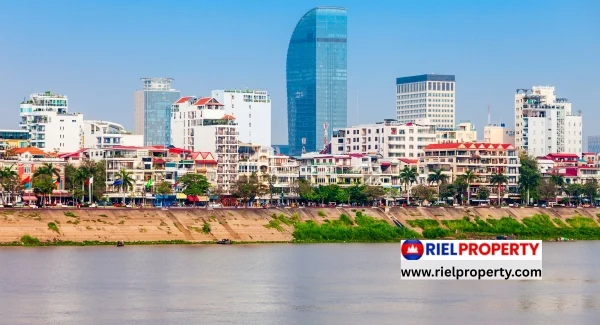
Cambodia’s real estate market in 2025 and 2026 looks confusing at first glance. National price indices are still sliding, yet prime Phnom Penh condos and landed borey homes are quietly recovering. Headlines talk about a slowdown, but transaction data shows more homes changing hands and selective price growth in the right locations.
This guide breaks down the mixed signals: why average prices are falling, why certain condos and borey projects are rising, and what that means if you are trying to decide whether to buy in Cambodia now.
The Headline Data That Looks Negative
National residential price indices show that average home prices in Cambodia have been drifting down for more than two years. One widely cited index reports that nationwide residential prices were down roughly 3.7 percent year on year in early 2026, marking well over twenty consecutive months of decline. On the surface, that sounds like a market under ongoing pressure.
There are reasons behind the national decline. Weak coastal markets with heavy oversupply, unfinished projects, and slow tourism recovery continue to drag averages lower. Some provincial cities also saw prices reset after speculative runs during the boom years, and tighter credit has made it harder to sustain past price levels in the more fragile parts of the country.
Prime Phnom Penh Condos: Selective Recovery
At the same time that the national index is falling, prime condo projects in core Phnom Penh districts have started to show price gains again. Market reports for late 2025 indicate that asking prices for higher quality condominiums in central Phnom Penh were up by around mid-single digits year-on-year, with average values above 2,800 dollars per square meter in the best-located projects.
The pattern is selective. Not every condo is rising, and poorly located or weaker quality towers still face heavy competition and pressure on pricing. The recovery is concentrated in better-built projects in established districts such as BKK1, Tonle Bassac and parts of the riverside, where rental demand and livability remain strong even in a slower economy. In these pockets, inventory is more limited, and buyers include both local professionals and foreign investors who are focused on yield and quality rather than short-term flips.
Borey and Landed Homes: Leading the Comeback
Where the recovery is clearest is in borey and landed housing. Transaction data for 2025 shows that overall home sales rose by more than 30 percent compared with the previous year, even as condo sales volumes fell by roughly 20 percent over the same period. Most of that growth came from borey projects and other landed homes targeted at the domestic middle class.
Landed housing in districts such as Sen Sok, Chbar Ampov, Chroy Changvar and other emerging corridors around Phnom Penh has been one of the most active segments of the market. Developers in these areas have adapted by launching smaller phases, pricing more realistically, and focusing on real end-user buyers rather than speculative traders. As a result, borey homes now absorb much of the real demand that used to be pushed into condos during the earlier boom.
Why the Signals Look Mixed
The mixed picture comes from looking at averages and segments separately. National indices treat a coastal project that is half built and empty in much the same way they treat a fully occupied borey development in a growing Phnom Penh suburb. When weaker areas fall, they pull down the national line, even if stronger segments are already stabilizing or rising.
Segment data tells a different story. Prime condos in a handful of central districts and borey housing in the more connected parts of greater Phnom Penh are already back on a shallow upward track, while weaker condos and marginal locations are still correcting. This is what market analysts mean when they describe Cambodia’s cycle as “selective” or “mature”: performance now depends more on asset quality, segment and location than on the market moving in one direction for everything.
| Segment | Recent Price / Volume Trend | Key Drivers |
|---|---|---|
| National residential index | Down about low single digits year-on-year, multi-year decline | Coastal oversupply, provincial corrections, tighter credit |
| Prime Phnom Penh condos | Up mid single digits in best projects, flat to down elsewhere | Location, build quality, rental demand, limited supply |
| Borey and landed homes | Sales volumes up more than 30 percent, prices stable to rising | Domestic middle class buyers, smaller phases, realistic pricing |
| Coastal and fringe condos | Still under pressure, slower absorption | Legacy oversupply, reputational issues, weaker tourism |
What This Means for Investors
For investors, the lesson is simple but important: do not read the national index as the final word on Cambodia’s property market. It tells you where the weakest parts of the market are pulling averages, not where specific opportunities are. A better approach is to decide which segment you care about, then look at price and volume trends inside that segment.
If you are focused on rental yield and exit liquidity, higher quality condos in central Phnom Penh remain viable, with realistic net yields and slowly recovering prices, as long as you are selective on project, developer and management. If you are targeting domestic demand and a longer hold, borey and landed housing in the better connected corridors around the city are absorbing most of the recovery and offer a different risk and return profile.
Coastal and fringe condos, especially in markets that saw the sharpest speculative booms before Covid, still belong in the “specialist” bucket: potential upside is higher if a full recovery takes hold, but risks are also higher, and the timing is more uncertain. For most first-time investors, those markets are better approached later, once core segments have stabilized, and personal experience with Cambodia’s property system has grown.
If you want to act on the mixed signals in a structured way, start with our yield guide for Cambodia condos, browse ready to move in properties if you prefer established projects, or look at off plan properties if you are comfortable with a longer horizon and staged payments. For a broader overview, our investment guides for foreign buyers walk through ownership rules, taxes and exit strategies in more detail.
Frequently Asked Questions
If the national index is falling, is it still a good time to buy?
It can be, depending on what you are buying and where you are buying it. Falling averages reflect stress in weaker segments, but better-located condos and borey homes in stronger districts are already stabilizing or recovering. The key is being selective and focusing on fundamentals, not just the index line.
Are borey homes safer than condos right now?
Borey and landed housing tied to real domestic demand has been more resilient than speculative condo projects, especially in emerging suburbs with improving infrastructure. They are not risk-free, but current transaction data shows they are absorbing much of the recovery, while weaker condos lag.
Should I avoid coastal condos entirely?
Not necessarily, but they are better suited to experienced investors who understand the local market and are comfortable with higher risk. Oversupply, unfinished projects and reputational issues mean recovery there is slower and more uncertain than in core Phnom Penh and borey segments.
How long will it take for prices to fully recover?
Cycles in property markets often take several years to work through. Analysts expect Cambodia’s market to move through a more disciplined, selective phase rather than a sudden surge, with recovery arriving segment by segment rather than all at once.

Thomas Kaspersky
I’m Thomas Kaspersky, specialising in property investment across several markets, including Cambodia, the UK, Dubai/UAE, and Poland. With experience as an engineer and project manager, I enjoy explaining how developments, construction, and market data shape real estate opportunities.
View all posts