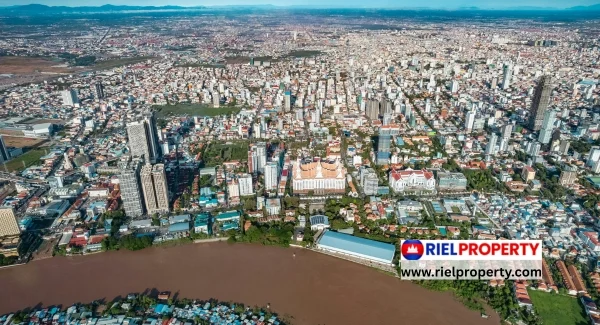
Over the past decade, land prices along Phnom Penh’s new infrastructure corridors have moved from tens of dollars per square meter to hundreds and, in some cases, thousands. Hun Sen Boulevard, Ring Road 3, and growth belts like Sen Sok, Chroy Changvar, and Kamboul have turned from peripheral locations into core parts of the city’s expansion story, tied directly to Techo International Airport and new expressway links.
This guide is for long-term investors. It explains how land values along key corridors have evolved, why land is a different asset than condos, and how to think about the main growth zones around Techo Airport and Ring Road 3.
How Corridor Land Prices Have Moved
Land along Phnom Penh’s southern and ring road corridors has seen some of the sharpest appreciation in Cambodia over the last 10 to 15 years. Reports on Hun Sen Boulevard show commercial land prices rising from around 200 dollars per square meter in 2013 to as high as 2,200 dollars per square meter by 2021, an increase of more than ten times in less than a decade. Residential land along the same corridor moved into the 500 to 2,000 dollars per square meter range.
Ring Road 3 and nearby districts such as Prek Pnov, Dangkor, and Chbar Ampov have also seen land values jump. In some belts, land moved from roughly 80 to 280 dollars per square meter into the 300 to 1,700 dollars per square meter band over a few years, with smaller plots directly fronting the road showing the highest growth rates. More recent 2026 land price reports show core Phnom Penh land on main roads still in the thousands per square meter, while peripheral zones such as Kamboul, rural Prek Pnov, and parts of Dangkao start as low as 20 to 50 dollars per square meter.
Why Land Is Different From Condos
Land is not just a cheaper way to “get exposure” to a corridor; it is a different kind of asset than a condo. Condos are income-focused: they generate rent, can be managed as turnkey investments, and have clearer resale markets. Land is optionality-focused: it typically produces little or no yield today, but carries potential for future development, subdivision, or resale at a higher price once infrastructure and demand catch up.
Land also carries different risks. It is more closely tied to infrastructure timelines, zoning changes, and long-term planning decisions. A good plot can lag for years if roads or utilities arrive late, or if the corridor develops differently than expected. On the other hand, well-chosen land can capture outsized appreciation when key projects move from announcement to completion, especially for smaller plots directly facing main roads.
Airport and Hun Sen Boulevard Corridor
The southern corridor running from inner Phnom Penh down Hun Sen Boulevard toward Techo International Airport is the clearest example of infrastructure-led land repricing. Prices along Hun Sen Boulevard were reported around 1,000 to 1,200 dollars per square meter in earlier years and have moved to around 2,000 dollars per square meter in the most central stretches, with some listings and transactions for prime lots at 1,300 to 1,700 dollars per square meter as of 2026.
Closer to the airport junction and Ring Road 3 intersections, industrial and large-scale residential land still offers lower entry points, with some parcels in Kandal province near the new airport marketed in the tens of dollars per square meter range for early-stage investors. As the airport and surrounding logistics and residential projects mature, these belts are expected to move up the value curve. Still, the pace will depend on actual delivery of roads, utilities, and anchor projects such as malls and industrial parks.
Ring Road 3 and Surrounding Belts
Ring Road 3 has lifted land prices in the adjacent zones even through the broader Covid-era slowdown. Land along key segments of the road saw increases on the order of 15 to 20 percent over some 12-month periods, with insiders noting that land prices tend to jump at each stage of major road projects: announcement, groundbreaking, and completion.
Along Ring Road 3, pricing depends heavily on which segment and how close a plot sits to major junctions. Some stretches between bridges and highways see land at 200 to 250 dollars per square meter, while more rural sections further from key intersections show ranges from 50 to 150 dollars per square meter. Smaller plots directly abutting the project often command higher per-square-meter prices than larger agricultural parcels a short distance away.
Chroy Changvar, Sen Sok, and Kamboul
On the northern and northwestern side of Phnom Penh, Chroy Changvar, Sen Sok, and Kamboul form another set of growth corridors. In Chroy Changvar, land at the developed southern tip can reach around 3,200 dollars per square meter, while more rural communes like Koh Dach remain as low as 100 dollars per square meter, highlighting the spread between mature and emerging micro-locations.
Sen Sok has evolved into a major residential and commercial hub, with main-road plots in popular communes reaching up to 3,600 dollars per square meter. Further out, peripheral districts such as Kamboul and parts of Prek Pnov and Dangkao offer entry prices starting from 20 to 50 dollars per square meter for larger rural parcels, reflecting early-stage positioning rather than current urban density. These zones are tied to future phases of ring roads and secondary infrastructure rather than the already established urban grid.
How to Build a Long-Term Land Strategy
A sensible land strategy around Techo Airport and Ring Road 3 starts from a few simple principles.
1. Anchor to Infrastructure Milestones
- Map where major roads, interchanges, and the airport access routes already exist today, and where future phases are planned.
- Favor plots with clear, direct frontages on main roads or junctions, or very short, realistic access routes to them; these tend to capture more of the value uplift when traffic and commercial activity grow.
- Understand that early-stage plots near announced projects may appreciate slowly until construction visibly progresses; do not assume every announcement will translate into the same price jump.
2. Match Corridor Stage to Your Time Horizon
- Mature corridors (Hun Sen Boulevard core, prime Chroy Changvar, Sen Sok): Higher land prices but clearer liquidity and shorter timelines for development or resale. Suitable for investors who prefer lower risk and shorter horizons but still want land exposure.
- Transitional corridors (segments along Ring Road 3, outer Chbar Ampov, Prek Pnov belts): Mid-range pricing with visible infrastructure but more room for growth as projects complete. Best for five- to ten-year horizons and investors who can tolerate slower early years.
- Early-stage corridors (outer Kamboul, rural belts near the airport): Lowest entry prices, but the longest and most uncertain timelines. These suit patient investors who can hold undeveloped land for many years and accept infrastructure risk.
3. Treat Land as a Portfolio Piece, Not a Whole Strategy
- Combine land exposure with income-producing assets such as borey homes or prime condos to balance optionality with cash flow.
- Use condos and borey properties for near-term yield and diversification, and land as a long-term optionality piece that may be developed, sold, or joint-ventured later.
- Avoid overloading on land in a single corridor, especially if that corridor is still early in its development cycle.
If you want to explore concrete opportunities along these corridors, start with our villa and borey listings in growth belts, then look at land plots where zoning and infrastructure are already clear. Our pages for ready to move in properties and off plan properties show where current projects are clustering, which is often a useful signal for where land demand is building.
For a broader context on districts and corridors, see our guide to Phnom Penh’s best areas, and for risk management read our article on developer distress risk together with our investment guides for foreign buyers.
Frequently Asked Questions
Has land along Techo Airport and Ring Road 3 already become too expensive?
Core stretches along Hun Sen Boulevard and some prime junctions have already moved into the hundreds or thousands of dollars per square meter range, reflecting past growth. However, secondary belts and early-stage zones near the airport and ring roads still offer entry points in the tens of dollars per square meter, with upside tied to future infrastructure delivery.
Is land safer or riskier than buying condos or borey homes?
Land is neither automatically safer nor riskier; it is different. It carries more dependence on infrastructure and planning, less immediate yield, and more optionality. Condos and borey homes have clearer rental and resale markets but can be more sensitive to oversupply and developer risk. A balanced portfolio can include both, as long as you understand the role each asset plays.
How long should I plan to hold corridor land?
For most investors, a realistic corridor land horizon is at least five to ten years. Price moves can be lumpy and often cluster around major project milestones. Trying to time short-term flips in land around infrastructure is difficult and carries higher risk.
Do I need to live in Cambodia to invest in land here?
No, but you should work with reliable local advisors and ensure clear title, zoning checks, and realistic access to utilities and roads. Land deals are more sensitive to documentation and local practice than standard condo purchases, so on-the-ground support matters more.
Should I focus on one corridor or diversify?
Diversifying across corridors and asset types is usually safer. Concentrating all your capital in a single road or airport belt magnifies local planning and infrastructure risks. Combining exposure to different belts and a mix of land, borey and prime condos can smooth your risk profile.

Thomas Kaspersky
I’m Thomas Kaspersky, specialising in property investment across several markets, including Cambodia, the UK, Dubai/UAE, and Poland. With experience as an engineer and project manager, I enjoy explaining how developments, construction, and market data shape real estate opportunities.
View all posts