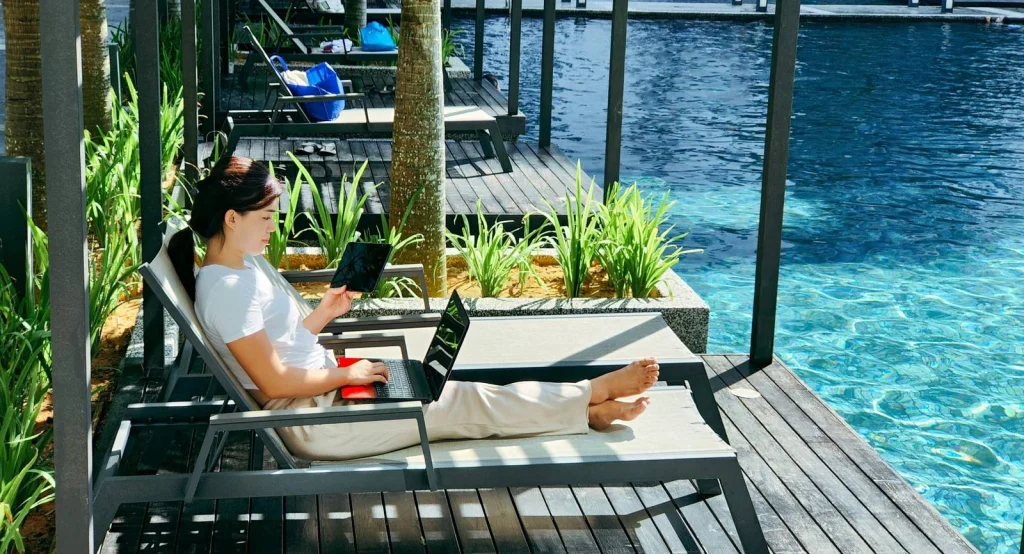
Bali, Chiang Mai and Da Nang have been the classic Southeast Asian bases for remote workers for years. Each still has a lot going for it. But visa rules, costs and property rules have shifted in 2026, and more nomads are asking a different question: not just where to spend the next three months, but where to settle for a few years and perhaps own a home.
That is where Phnom Penh enters the conversation. It is not the most famous nomad city in the region, and it is not trying to be Bali. What it offers is a simple long-stay visa, a US dollar economy, lower costs than most rivals, and one of the few routes in the region for foreigners to hold freehold title to a condo.
This guide explains how the four cities compare on visas, cost of living, work and lifestyle, what foreigners can actually own in each country, and how to test Phnom Penh before you commit.
The four cities side by side
| Phnom Penh | Bali | Chiang Mai | Da Nang | |
|---|---|---|---|---|
| Main long-stay route | E-class visa plus EB extension, up to 12 months at a time | E33G remote worker visa, 1 year | DTV, 180 days per entry over 5 years | 90-day e-visa, then exit and reapply |
| Income or savings test | None for the visa; work permit needed for longer EB | USD 60,000 a year from abroad | 500,000 baht in savings | None, but no remote work framework |
| Currency | US dollar widely used | Rupiah | Baht | Dong |
| Foreign home ownership | Freehold strata title on condos, 70% quota | Leasehold or Hak Pakai only | Freehold condos, 49% quota | 50-year apartment ownership, 30% quota |
| Best for | Long stays, low costs, owning a home | Lifestyle and community | Mature nomad scene, calm pace | Beach city, short stays |
Rules in all four countries change often. Treat this as a starting point and confirm details before you apply.
Visas for remote workers in 2026
Bali (Indonesia)
Indonesia’s E33G remote worker visa lasts one year and requires at least USD 60,000 a year in income from outside Indonesia, plus health insurance. It cannot be extended, so you reapply to stay longer. Holding it can also make you an Indonesian tax resident, which is worth checking with an adviser.
Chiang Mai (Thailand)
Thailand’s Destination Thailand Visa (DTV) is a five-year, multiple-entry visa allowing 180 days per entry, with one 180-day extension. You need 500,000 baht in savings, and since August 2026 you must apply in your country of nationality or residence. Thailand also cut its visa-free stay to 30 days for most nationalities from 15 September 2026, so the DTV is now the main route for most nomads.
Da Nang (Vietnam)
Vietnam offers a 90-day e-visa to all nationalities, with single or multiple entry. There is no digital nomad visa and no clear legal framework for remote work, so long stays mean leaving and applying again.
Phnom Penh (Cambodia)
Cambodia has no dedicated nomad visa, but it does not need one for most people. You arrive on a $35 E-class (Ordinary) visa and extend it in-country with an EB business extension for 1, 3, 6 or 12 months, renewable indefinitely. Remote workers fall under the self-employment rules, and longer EB extensions now require a valid work permit, which costs around $130 a year through the Ministry of Labour’s online system. Our guide to moving from Thailand to Cambodia covers the process step by step.
Cost of living compared
Phnom Penh and Da Nang are usually the cheapest of the four for day-to-day living. Chiang Mai sits close behind and remains good value. Bali has become noticeably more expensive in popular areas such as Canggu and Uluwatu, especially for villa rentals.
Phnom Penh’s advantage is less about the lowest possible price and more about what you get for it. A modern serviced condo in a central district often includes a gym, pool, security and reliable backup power, at a rent that would only buy a basic room in parts of Bali. Because rents and prices are in dollars, your budget also does not move with the local currency.
For current rental figures by district, see our Phnom Penh rental cost and yield guide.
Work setup and lifestyle
- Bali: the strongest nomad community and coworking scene, beaches and surf, but heavy traffic and rising costs.
- Chiang Mai: a relaxed, established nomad base with good cafes and healthcare, though air quality during the burning season is a real issue for many.
- Da Nang: a clean, modern beach city with improving coworking options and easy flights within Vietnam.
- Phnom Penh: a busy capital with a large expat population, good fiber internet in most condo buildings, coworking spaces and cafes across BKK1 and Toul Kork, and a growing food and nightlife scene. It is a city, not a beach town, but the coast is a short flight or drive away.
Can you own a home? The ownership rules compared
This is where the four places differ most, and where Phnom Penh stands out for nomads who want to stop paying rent.
- Indonesia (Bali): foreigners cannot own freehold land. Most villas are sold as leaseholds, typically 25 to 30 years. A registered Hak Pakai right is possible for residents with a KITAS, subject to minimum prices of IDR 5 billion for houses and IDR 2 billion for apartments. Nominee arrangements are illegal and, since a 2026 Bali regulation, can carry criminal risk.
- Thailand (Chiang Mai): foreigners can own condo units freehold, within a 49% foreign quota per building, with funds brought in from abroad.
- Vietnam (Da Nang): foreigners can own apartments in approved commercial projects for 50 years, renewable once, within a 30% quota per building.
- Cambodia (Phnom Penh): foreigners can own condo units freehold on strata title, from the first floor up, within a 70% foreign quota per building. Prices and payments are in US dollars.
For a nomad, that combination matters. In Phnom Penh you can buy a condo outright, live in it while you are in the country, and rent it out when you travel. Many buildings offer property management to handle tenants for you.
Why some nomads choose Phnom Penh
- Simple long stays: a 12-month extension with no income or savings threshold for the visa itself.
- Dollar economy: no currency swings on rent, bills or property.
- Real ownership: freehold strata title, not a lease.
- Lower entry prices: a well-located condo can cost a fraction of a comparable unit in Bangkok or a Bali villa lease.
- Flexible ways to buy: staged payment plans on off-plan projects, or ready condos you can move into now. Some sellers also accept crypto, which our crypto buying guide explains.
There are trade-offs. Healthcare for complex cases often means flying to Bangkok or Singapore, infrastructure outside the center is still developing, and Phnom Penh prices have softened over the past two years, so choosing the right building matters. Riel Property can share current prices, management standards and developer track records before you decide.
The next hotspot: Cambodia’s coast
Many nomads who base themselves in Phnom Penh spend part of the year on the coast. Koh Rong was ranked ninth in The World’s 50 Best Beaches 2026, an international airport is being built on the island, and Sihanoukville is the subject of a new provincial tourism plan for 2026 to 2030. Prices on the coast are still low compared with Bali or Phuket.
Ownership on the islands works differently from Phnom Penh condos, so read the details first. Our guide to Koh Rong as Cambodia’s next island hotspot explains the opportunity and the risks. For strata title condos by the sea, see projects such as Time Square 10 Sihanoukville.
How to test Phnom Penh before you commit
- Month 1: arrive on an E-class visa, rent a serviced condo in BKK1 or Toul Kork on a short lease, and try a few coworking spaces.
- Month 2: arrange an EB extension through a reputable agent, register for a work permit, and open a local dollar bank account.
- Month 3: if the city suits you, shortlist buildings, compare ready and off-plan options, and check developer history before reserving a unit. Riel Property can arrange viewings around your work schedule.
Our investment guides cover rental yields and market data if you plan to rent the home out while you travel. And if you are selling a home elsewhere to fund the move, specialist buyers such as Quick House Buyer in the UK and Sell Property Fast in the UAE can speed up that step.
Free download: The Cambodia Property Guide 2026 covers ownership rules, costs and taxes, off-plan buying, visas, where to buy and realistic returns in one 22-page PDF.
Frequently asked questions
Does Cambodia have a digital nomad visa?
No. Most remote workers use the E-class visa with an EB extension of up to 12 months, renewable in-country. Longer EB extensions require a valid work permit.
Is Phnom Penh cheaper than Bali for digital nomads?
Generally, yes. Rents for modern condos in central Phnom Penh are usually lower than villa rents in Bali’s popular areas, and costs are in US dollars.
Can a digital nomad buy property in Cambodia?
Yes. Foreigners can own condo units freehold on strata title from the first floor up, as long as foreign ownership stays within 70% of a building’s units.
Can foreigners own property in Bali?
Not freehold. Foreigners usually buy leaseholds, or hold a Hak Pakai right with a residence permit and minimum price thresholds. Nominee arrangements are illegal.
Which is better for nomads, Chiang Mai or Phnom Penh?
Chiang Mai has the more established nomad scene, but needs a DTV with 500,000 baht in savings for long stays. Phnom Penh is a better fit if you want a simple long-stay extension, dollar pricing, or to own a home.
Can I buy a condo in Phnom Penh with crypto?
Some sellers and developers accept crypto through licensed channels. Always complete the purchase with a proper sale agreement and strata title transfer.

Sophea Lin
I’m Sophea Lin, a property consultant and market researcher with Riel Property, based in Phnom Penh. I have 12 years of experience working with home buyers, first-time buyers and overseas investors across Phnom Penh and Sihanoukville, helping them compare projects, understand ownership rules and buy with confidence. I write about relocation, the buying process and living in Cambodia.
View all posts