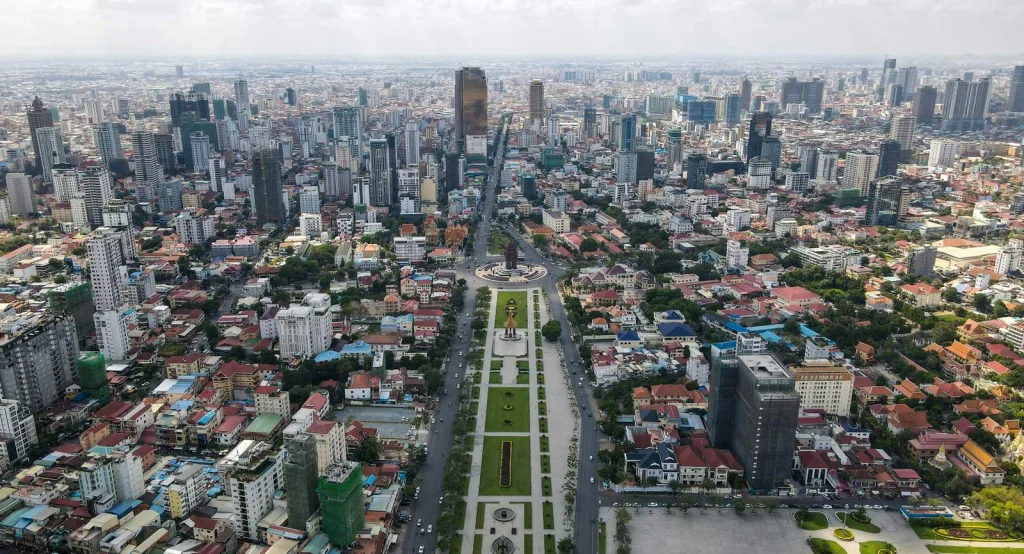
When people picture a move to Southeast Asia, they usually think of Bangkok, Bali or Ho Chi Minh City. Phnom Penh rarely makes the first list. Yet over the past decade Cambodia’s capital has changed faster than almost any city in the region, from a low-rise town into a capital of glass towers, international schools, riverside promenades and a new international airport.
It is not a perfect city, and it is not for everyone. But for a growing number of professionals, remote workers, families and retirees, it offers a combination that is hard to find elsewhere: a dollar economy, simple long-stay visas, the right to own your home, and a cost of living well below most regional capitals.
This guide explains the 12 main reasons people are moving to Phnom Penh in 2026, the things that are genuinely harder, which neighborhoods suit which lifestyles, who the city suits best, and a realistic 90-day plan for making the move.
12 reasons people are moving to Phnom Penh
1. Everyday life runs on the US dollar
Rents, salaries, restaurant bills and property prices are quoted in US dollars, and ATMs dispense them. If your income or savings are in dollars, there is no exchange rate to watch. If they are in another currency, your home and your rent are at least priced in one of the world’s most stable currencies.
2. Long-stay visas are simple
You arrive on a $35 E-class (Ordinary) visa and extend it in-country for up to 12 months at a time. Workers and business owners use a business extension, and retirees aged 55 and over use a retirement extension with no published minimum deposit. Both can be renewed year after year without leaving the country.
3. You can own your home
Foreigners can own condo units freehold on strata title, on any floor above ground level, within a 70% foreign limit per building. Few countries in the region offer foreign buyers real ownership of their home in their own name. Our guide to hard, soft and strata titles explains what you receive.
4. The cost of living is lower than most regional capitals
Local food, transport, domestic help and utilities are inexpensive, and a modern serviced condo in a central district often costs less than a basic apartment in Bangkok, Singapore or Hong Kong. Imported goods, international schools and private healthcare cost more, so budget for the lifestyle you actually want.
5. Housing for every lifestyle
The city now offers serviced apartments for short stays, modern condo towers with pools, gyms and backup power, townhouses and villas in gated boreys, and riverside homes with space and views. Most newcomers rent first and buy once they know the city.
6. Distinct neighborhoods
Each district has its own character, from the walkable expat streets of BKK1 to the newer riverside communities of Chroy Changvar and Koh Pich. The neighborhood guide below helps you narrow it down.
7. International schools
Phnom Penh has a wide choice of international schools teaching the IB, Cambridge, American, Australian and French curricula. Annual tuition typically ranges from about $3,500 to $12,000 for early years, rising to around $10,000 to $28,000 for the final IB or A Level years, so families have options across a range of budgets. Many families choose Toul Kork, Chroy Changvar or Sen Sok for space and shorter school runs.
8. Healthcare for everyday needs
Several private hospitals and international clinics, including one managed by Thailand’s Bangkok Dusit Medical Services group, handle routine care well. Complex treatment often means flying to Bangkok or Singapore, so international health insurance with evacuation cover is essential.
9. A new airport and regional connections
Techo International Airport opened in 2025 and connects Phnom Penh with regional hubs such as Bangkok, Singapore, Kuala Lumpur, Seoul and Taipei. Most major Asian cities are a short flight away, which suits remote workers and anyone with family overseas.
10. Food, cafes and the riverfront
The city has a lively food scene, from Khmer street food to international restaurants, rooftop bars and specialty coffee. The riverside promenade, markets and pagodas give it a character that newer cities lack.
11. An international community
Diplomats, NGO staff, entrepreneurs, teachers and remote workers make up a large, welcoming expat community. English is widely used in business, and it is easy to build a social and professional network quickly.
12. The coast and islands are within reach
Kampot, Kep and Sihanoukville are a few hours away by road, and the islands of Koh Rong are a short ferry ride from Sihanoukville. Our guide to Koh Rong as Cambodia’s next island hotspot covers the coast in more detail.
What is genuinely harder
- Traffic and heat: traffic is heavy at peak times, and the hot season from March to May is intense.
- Rainy season: heavy downpours from roughly June to October can flood some streets for an hour or two.
- Healthcare for serious conditions: plan and insure for treatment abroad.
- Paperwork: visas, work permits and banking are simple compared with many countries, but rules change, so use reputable agents and keep documents current.
- Property choice matters: prices across the city softened in 2025 and 2026, while well-managed buildings in prime districts held up better. Choosing the right building is more important than timing the market.
Which neighborhood suits you?
| Neighborhood | Character | Suits |
|---|---|---|
| BKK1 | Central expat district, cafes, embassies, serviced condos | Professionals, remote workers, investors |
| Tonle Bassac | Central, upscale towers, close to the river and government district | Executives, couples, prime investors |
| BKK3 and Toul Tom Poung | Quieter streets, Russian Market, cafes | Long-stayers, first-time buyers |
| Toul Kork | Residential, larger homes, newer projects | Families |
| Daun Penh and Riverside | Historic center, walkable, river views | Retirees, lifestyle buyers |
| Chroy Changvar and Koh Pich | Newer riverside districts, planned communities | Families, buyers wanting space |
Our guide to the best areas to buy in Phnom Penh and our district guide compare each area in more depth, and the Riel Property team can suggest buildings that match your budget and lifestyle.
Who Phnom Penh suits
- Professionals and entrepreneurs who want a regional base with low running costs. See our guide for American buyers if you are moving from the US.
- Remote workers who value simple long stays and modern condos. Our comparison of Phnom Penh, Bali, Chiang Mai and Da Nang explains the trade-offs.
- Families who want international schools and more space for their budget.
- Retirees looking for a renewable retirement visa and affordable city living. Our guide to retiring in Cambodia covers the details.
- Expats leaving Thailand after its visa and banking changes, as our guide to moving from Thailand to Cambodia explains.
A realistic 90-day moving plan
- Before you go: arrange international health insurance, gather documents such as degree certificates or pension letters, and shortlist neighborhoods and schools.
- Weeks 1 to 2: arrive on an E-class visa, stay in a serviced apartment and view neighborhoods.
- Weeks 2 to 4: sign a lease, apply for a business or retirement extension and, if you will work, start the work permit process.
- Weeks 4 to 6: open a local US dollar bank account and set up your phone, internet and transport.
- Weeks 6 to 12: settle in. If you plan to buy, compare buildings and developers. On a ready unit, the strata title transfer usually takes around 12 weeks from signing.
Rent first, then buy
Most newcomers rent for six to twelve months before buying. When you are ready, you can choose ready condos to move into straight away or off-plan projects with staged payment plans. Payment is usually by bank transfer in US dollars, and some sellers accept cash or crypto, as our crypto buying guide explains. Our guide to the full cost of buying sets out the fees.
Riel Property’s experienced agents in Cambodia can show you buildings by video call before you arrive and arrange viewings once you land. For everything in one place, download our free Cambodia Property Guide 2026, and see our investment guides for yields and market data. If you are selling a home elsewhere to fund the move, specialist buyers such as Quick House Buyer in the UK and Sell Property Fast in the UAE can speed up that step.
Frequently asked questions
Is Phnom Penh a good place to live for expats?
For many people, yes. It offers a US dollar economy, simple long-stay visas, modern condos, international schools and a large expat community, at a lower cost than most regional capitals. Traffic, heat and limited specialist healthcare are the main drawbacks.
How long can I stay in Cambodia?
You arrive on a $35 E-class visa and extend it in-country for up to 12 months at a time, renewable indefinitely, using a business or retirement extension.
Can foreigners buy a home in Phnom Penh?
Yes. Foreigners can own condo units freehold on strata title on any floor above ground level, within a 70% foreign limit per building. Foreigners cannot own land directly.
Which area of Phnom Penh is best for families?
Toul Kork, Chroy Changvar and Sen Sok are popular with families for larger homes, more space and access to international schools.
How much are international schools in Phnom Penh?
Annual tuition typically ranges from about $3,500 for early years to around $28,000 for the final IB or A Level years, depending on the school.
Should I rent or buy when I move to Phnom Penh?
Most people rent for six to twelve months first, then buy once they know the city and the neighborhood they prefer.

Sophea Lin
I’m Sophea Lin, a property consultant and market researcher with Riel Property, based in Phnom Penh. I have 12 years of experience working with home buyers, first-time buyers and overseas investors across Phnom Penh and Sihanoukville, helping them compare projects, understand ownership rules and buy with confidence. I write about relocation, the buying process and living in Cambodia.
View all posts